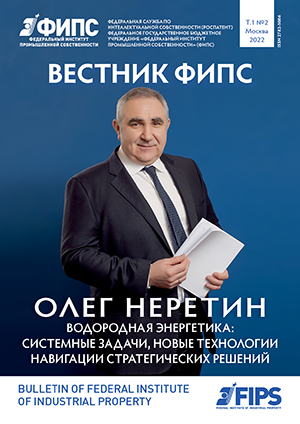
The scientific and practical journal Bulletin of Federal institute of industrial property was founded in 2022 to highlight the results of scientific activities in the field of intellectual property in the following fields of science: State and law. Legal sciences; Economics. Economic sciences; Patent law. Invention. Innovation; Natural sciences. General and complex problems; Statistics; Cybernetics. The mission of the journal is to promote the results of the latest research, both fundamental and applied, on the entire range of intellectual property issues. The founder and publisher is the "Federal Institute of Industrial Property" (FIPS).
Current issue
EDITORIAL
ISSUES OF INTELLECTUAL PROPERTY RIGHTS PROTECTION AND ENFORCEMENT
in the context of technological development, knowledge and intellectual property (IP) are becoming key drivers of innovation. The article covers establishing the relationship between the most important concepts of the IP system, namely “information”, “knowledge”, “result of intellectual activity” (RIA) and “object of protected IP” in order to further apply the identified relationship in artificial intelligence (AI) systems. To achieve this goal, it becomes necessary to integrate philosophical, legal and economic approaches to understanding RIA from the standpoint of IP within the framework of the knowledge cycle with the carrier “knowledge” and with the carrier “information”. To do this, the following tasks are set: to analyze the philosophical foundations of RIA (according to G.V.F.Hegel and K. Popper); to characterize the properties of knowledge as a resource; to determine the role of exclusive rights in creating the “rarity” of knowledge; to substantiate the nature of the “social contract” and identify the “convertibility”, similarities and differences between information and knowledge (based on Wiener’s work), as well as to establish the possibility of an adequate representation within the framework of classical and fuzzy logic of the connection between the “IP object” (OIP) and “RIA” for subsequent application in AI systems. The research is based on a systematic approach and philosophical and legal analysis. Logical constructions and comparison of categories are used to understand the phenomenon of objectification of knowledge and subjectification of information. Taking into account the revealed transformation mechanism, the novelty lies in distinguishing the philosophical (broad) and legal (narrow) scope of the RIA concept. The scientific novelty is stated by the author through the sphere of demarcation of the philosophical and legal scope of the concepts of RIA and is reduced to the analysis of the convertibility of the pair of concepts “information” and “knowledge” representing RIA and its binding to the concept of “protected IP object”. For the first time, the research uses the apparatus of binary logical operations and the implication “If … then …” to formalize the logical-ontological relationship between the categories “OIP” and “RIA”. The practical conclusion is that the category of “Protected IP object”, which includes protected, protectable and unprotected IP, cannot be adequately represented within the framework of classical logic, “modus ponens”, but are based on approximate judgments and require the use of fuzzy logic. This means that in practical applications (IC modeling, AI, etc.), it is necessary to use fuzzy neural networks (FNS). It is shown that IP turns knowledge into a commodity through a legal monopoly. The conclusion is made: the informational nature of the RIA does not absorb its IP legal regime. The relationship between OIP and RIA is represented through truth tables within the framework of classical and fuzzy logic. The findings are applicable to improving legislation and asset management in the digital environment. Further research will focus on the impact of artificial intelligence on the turnover of knowledge in the digital environment and the use of the results in fuzzy neural networks.
rapid technological development and the transition to a knowledge-based economy create a high degree of uncertainty regarding the future structure of employment and the required qualifications. Traditional labor market forecasting tools are oriented towards retrospective analysis and short-term perspectives, which does not allow for timely detection of technological shifts at the early stages of their emergence. The article presents an original approach to forecasting changes in professional competencies, built upon a Russian adaptation of a foreign method that uses text vector representations to establish links between occupational domains and patent activity. Unlike the original method, the proposed framework additionally takes into account scientific publication data, making it possible to detect emerging technological directions. The data sources include the Register of Professional Standards, the International Patent Classification, and the classifier of the Russian Institute of Scientific and Technical Information. A unified semantic space is formed using a word embedding model trained on a combined corpus of texts from professional standards, descriptions of patent classes, and scientific rubrics. The alignment of professional functions with technological classifiers, together with the analysis of patent and publication activity dynamics, enables the construction of two independent forecast tracks: a short-term track with a horizon of 3–7 years, reflecting changes in already established professions, and a long-term track with a horizon of 10–15 years, aimed at identifying competencies that may become in demand in the future. The proposed approach is theoretical in nature and does not replace existing forecasting methods but rather complements them by providing an additional objective channel of information about technological changes at early stages. Further research should be directed towards experimental testing of the proposed approach and its validation on a representative dataset in order to assess the adequacy of the forecast.
today, regional brands are a powerful tool for the economic development of territories, contributing to the promotion of unique goods and services, as well as preserving the cultural heritage of the regions. In Russia, where regions have significant autonomy in the field of socio-economic development, the legal regulation of regional brands is becoming particularly relevant. Regional brands are being integrated into import substitution and export potential strategies. At the same time, effective development of regional brands is impossible without their proper legal protection. The relevance of the study is due to the increasing role of regional brands in the socio-economic development of the subjects of the Russian Federation and the need to improve the legal protection for Protected Designation of Origin (PDO) and geographical indications (GI`s). The aim of the work is to identify gaps in legal regulation that violate the balance of interests of copyright holders and bona fide manufacturers, as well as to develop proposals to eliminate them, including the possibility of applying the institute of pre–use law by analogy with patent law. The research uses the methods of logical and system analysis, as well as the comparative method. The legal basis was made up of regulatory legal acts of Russia, while the empirical basis was statistical data and court decisions. The current regulation does not provide an adequate level of information to market participants about the registration of PDO and GI, and does not provide for mechanisms to protect manufacturers who have used the relevant designations in good faith. The scientific novelty lies in the justification of the need to introduce a sub-institution of the right of pre-use in relation to PDO and GI, as well as in the development of specific proposals to improve notification procedures through chambers of commerce and industry and the introduction of a transitional period (at least one and a half years). The practical significance of the results lies in the possibility of their use in the improvement of civil legislation and the formation of law enforcement practice. The conclusion is made about the expediency of a comprehensive reform of legal regulation aimed at protecting bona fide producers without prejudice to the interests of consumers. The prospects for research are related to the development of mechanisms to prove the extent of misuse and prevent abuse of this right.
the article analyzes the legal nature of microelectromechanical systems (MEMS) and substantiates the impossibility of their protection under the special legal regime similar to that for integrated circuit (IC) layout designs. The author demonstrates that, despite the similarity of basic manufacturing processes, MEMS and ICs are fundamentally different objects: while ICs are static electronic circuits, the value of MEMS lies in their microscopic movable mechanical elements that perform functions of interacting with the physical world. Based on a detailed comparative analysis of legal approaches in the USA, EU, Japan and China, the article proves the absence of a special registration system for MEMS in world practice. In all jurisdictions studied, the protection of MEMS is provided by the classical instruments of patent law, which ensure legal protection of their functional essence, as well as by the trade secret regime (know-how).The work reveals significant risks of erroneous registration of MEMS as IC layout designs that have emerged in Russian law enforcement practice since 2014, including the disproportionality of the scope of protection provided, legal uncertainty and devaluation of the special legal institution. It is concluded that the existing patent law framework is adequate and effective for the protection of MEMS, and no special regime is required for them. In conclusion, measures are proposed to adjust law enforcement practice and amend the Administrative Regulations for the Registration of Layout Designs, aimed at eliminating legal uncertainty and redirecting developers toward
patent protection. The research is of a comprehensive interdisciplinary nature. Its methodological basis is a synthesis of comparative legal and technical-legal analysis, supported by dogmatic and systemic approaches. This allows not only to ascertain the current state of affairs, but also to identify cause-and-effect relationships between technology and law, offering convincing practical conclusions. The article will be useful for developers and engineers to understand the consequences of choosing a method for protecting technologies and to build an intellectual property protection strategy; for patent attorneys and lawyers as a methodological guide for distinguishing between IC layout designs and MEMS objects; for managers and investors to assess the value of patent portfolios and minimize risks when financing MEMS developments; for lecturers and students as educational material demonstrating an interdisciplinary approach to the protection of new technologies.
the article examines the legal nature and limits of admissibility of joint ownership of the exclusive right to a trade secret (know-how) in Russian civil law. Special attention is paid to the conflict between the general rule on plurality of rightholders (Article 1229 of the Civil Code of the Russian Federation) and the special regulation enshrined in Article 1471 of the Civil Code. The authors analyze the imperative nature of the rule on the employer’s ownership of a service know-how and the dispositive nature of the rules for contract agreements and R&D contracts. The article discusses current law enforcement problems associated with the inability for a private investor to become a co-owner of a know-how created under his order. Based on the analysis of the doctrine and recent legislative initiatives of the Ministry of Education and Science of Russia, ways to improve civil legislation in terms of consolidating the possibility of joint ownership of trade secrets are proposed.
the article examines current issues of legislation and law enforcement practice in the field of patent law regarding the payment of remuneration to authors of the results of intellectual activity. The main attention is paid to the analysis of the existing norms governing the calculation of the amount of remuneration for the use by the employer of the created as-built objects. The work revealed a key problem that impedes the implementation of the principle of constitutional justice in determining the amount of remuneration: the influence of various related factors on the total amount of payments. The author offers a comprehensive approach to solving this problem, based on the analysis of causal relationships and the classical theory of labor value. The concept of determining the fair amount of remuneration taking into account the primary cost of an intellectual product has been developed. A new approach to the legislative regulation of this issue is proposed, taking into account the essence of remuneration as a special type of income. The scientific novelty of the study is the introduction of the concept of the primary cost of remuneration, the development of a model for the structural determination of the amount of payments, the creation of a function of the dependence of remuneration on inflation, the analysis of the influence of various factors on the total amount of payments. The practical significance of the work lies in the possibility of using the proposed changes in legislation to improve the system of legal regulation of relations between employers and authors of intellectual products. An analysis of the judicial practice of considering cases related to intellectual work in conditions of high workload on courts of general jurisdiction is also presented.
REGIONAL AND SECTORAL ECONOMICS
in the context of the large-scale transformation of the national economy, the digitalization of intellectual property (IP) management is a pressing issue. The solution is aimed at improving the efficiency and quality of managing patent information business processes and IP assets. The objective of this research is to develop fundamental principles for building an effective IP management system for organizations and enterprises. To this end, the key objectives of IP management are formulated, the requirements for creating an effective IP management system in the current environment are considered, the basic principles of digitalization of IP management are introduced, methods and approaches for the digital transformation of the IP management system are considered, directions for the development of tools and systems for digitalization of IP, the construction of an IP ecosystem and an electronic (digital) IP management body are considered. The purpose and main characteristics of certain known information technologies and IP management systems are presented. The research methods used include studying and analyzing key areas of development of information technologies and systems in the field of IP, classifying and systematizing specialized technologies and systems, the use of which improves the efficiency and quality of IP management. The results obtained in the study can be used in building an effective IP management system for organizations.
PATENT INFORMATION
the article was prepared based on the results of the research work of the Federal Institute of Industrial Property “Conceptual modeling of the architecture of the traditional knowledge information system”. The relevance of the research is determined by the need to understand national capabilities and approaches to the protection of traditional knowledge within the framework of the intellectual property legal system and to ensure high efficiency in the prior art search during the examination of applications for the registration of intellectual property rights. The aim of the research is to identify the main characteristics (properties) of an information system for traditional knowledge. The article presents the results of modeling the information space of traditional knowledge and the information structure of the Digital Information System for Traditional Knowledge (DIS TK), identifies the main actors of the information system and their functions. Based on this research, a conceptual model of the architecture of the information system for traditional knowledge was built. The information system for traditional knowledge is presented as a set of functional and supporting components (technical, software, information, organizational, legal, etc.) that solve the problems of aggregating information about traditional knowledge from the information space of heterogeneous sources and adapting this information in accordance with the requirements of the intellectual property field. The core of the information system for traditional knowledge is a traditional knowledge database. Representatives of Indigenous Peoples of Russia, specialists from various fields, scientific and educational organizations, enterprises, libraries, and executive authorities should be involved in the process of building the information collection of the database.
КНИЖНАЯ ПОЛКА

ISSN 2959-2432 (Online)